

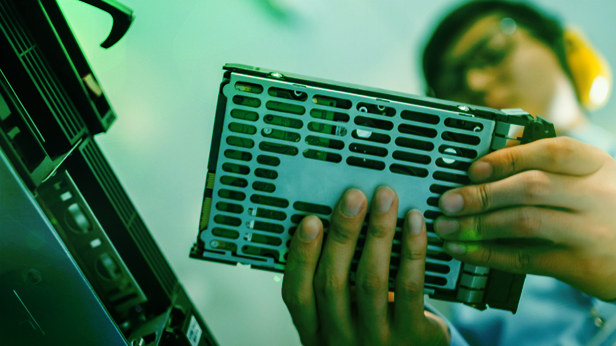
The AI infrastructure buildout is creating one of the largest data center hardware investment cycles the technology industry has ever seen.
New GPUs, high-capacity memory, enterprise storage, networking systems and purpose-built AI servers are moving into data centers at extraordinary scale. NVIDIA reported $89 billion in data center revenue for its second quarter of fiscal 2027, up 117% from the prior year. TrendForce has also linked tight memory supply and rising prices to strong cloud and AI infrastructure demand.
But every infrastructure buildout eventually creates movement in the other direction.
Systems are upgraded. Configurations change. Equipment is redeployed. Earlier generations enter AI hardware recovery, resale, refurbishment and parts channels.
AI hardware is beginning to reshape the secondary market for data center equipment. The question is whether traditional AI hardware valuation models can keep up.
It’s Not One Asset Class
It is tempting to treat used AI hardware and AI infrastructure as a premium category and apply a broad pricing assumption. But in today’s environment, that isn’t enough.
The economics and secondary-market value of AI hardware can vary dramatically based on:
- GPU model and memory capacity
- Server architecture and configuration
- Interconnect and networking components
- Installed DRAM and storage
- Power and cooling requirements
- Manufacturer support
- Condition and usage history
- Compatibility with current software stacks
- Buyer access and geographic demand
Two servers from the same product family may have very different secondary-market value. A complete system may be valuable to one buyer while another buyer is interested only in its GPUs, memory, storage or network components.
The model name provides identification. It does not provide the full economic answer—or an accurate data center hardware valuation.
New Infrastructure Does Not Make Every Prior Generation Obsolete
The primary AI infrastructure market is focused on performance leadership. Buyers are building for larger models, faster training, inference at scale and more efficient compute.
The secondary AI hardware market serves a wider range of needs. Earlier-generation hardware may still support:
- Smaller AI workloads
- Inference deployments
- Research and development
- Private cloud environments
- Regional operators
- Testing and development clusters
- Traditional high-performance computing
- Replacement parts and spares
That creates AI hardware resale and reuse opportunities, but it also makes valuation more complex. An asset can be outdated for one workload and economically useful for another. The correct question is not simply, “Is this current?” It is, “Who can still use this configuration, in what form and at what net recovery?”
Static Pricing Models Miss Configuration Economics
Traditional technology asset valuation workflows often begin with a model-level reference price and adjust for grade or age. That approach becomes less reliable when the component spread inside the asset is large.
For AI and data center hardware, value may be concentrated in a small number of components. Memory, GPUs and other accelerators, high-performance storage and networking can each respond to different supply and demand conditions.
A static device price may miss:
- A high-value GPU configuration
- Memory that is retaining value differently from the base server
- Storage that should be evaluated separately
- Network hardware with demand outside the original system
- A parts opportunity when complete-system demand is limited
This is the same challenge IT asset disposition (ITAD) providers have faced with other technology categories, but the financial consequences can be much larger when individual components carry significant value. For organizations managing high-value AI infrastructure, understanding component-level valuation can therefore be just as important as understanding the value of the complete system.
Timing Matters, but Forecasting is Not Certainty
AI hardware resale markets can move quickly. New product generations, supply availability, export controls, software compatibility and buyer investment cycles can all influence secondary demand and GPU resale value. That makes timing important. It does not make future pricing predictable with certainty.
AI hardware valuation models should use current market evidence and historical behavior to improve today’s decision. They should not turn directional intelligence into a guaranteed future price.
Practical questions include:
- Is demand strengthening or narrowing?
- Is value concentrated in the complete system or its components?
- Does the asset have a strong resale channel now?
- What processing is required before sale?
- How quickly is the configuration likely to lose relevance?
- Does redeployment create more value than external resale?
Better secondary-market intelligence helps teams make a more informed decision. It does not eliminate market risk.
What a Modern AI Hardware Valuation Model Needs
AI infrastructure can’t be valued accurately with a static price table. The market moves too quickly, configurations vary too widely, and a system’s value may be concentrated in individual components rather than the asset as a whole.
A modern AI hardware valuation model needs to connect the full picture. From what the asset is to what it could be worth across different disposition paths, that means bringing together five critical layers:
- Start with accurate asset identification. Before assigning value, organizations need to know exactly what they have, including the system, configuration and installed components. Small differences in GPUs, memory, networking or storage can create significant differences in AI hardware resale value.
- Understand where the value actually sits. The system-level price only tells part of the story. Component intelligence helps identify which parts of an asset are driving its value—and whether those components may be worth more through reuse or resale than as part of the complete system.
- Bring in broader market intelligence. Internal sales history is useful, but it’s inherently backward-looking. Accurate data center asset valuation also requires current signals on market demand, pricing, supply and buyer behavior to understand what an asset is worth today.
- Compare every viable disposition path. Reselling an asset intact isn’t always the best economic outcome. A stronger model evaluates resale alongside redeployment, refurbishment, component harvesting, wholesale and recycling to identify where the greatest asset recovery value exists.
- Factor in the true cost of recovery. Gross resale value isn’t the same as net recovery. Testing, labor, logistics, storage, channel fees and time all affect the final return and need to be part of the valuation equation.
When these layers work together, valuation becomes more than a point-in-time estimate. It becomes a decision-making tool—one that helps organizations determine not only what an AI hardware asset is worth, but the best path for recovering that value.
Without that broader view, organizations risk using yesterday’s model-level assumptions to value a category that now changes at component speed.
Intelligence for the Next AI Hardware Lifecycle
G2RL helps data centers, neoclouds, ITADs, OEMs and infrastructure operators evaluate AI and data center technology assets at both the system and component levels. By connecting asset identification, valuation, market context and disposition intelligence, G2RL helps teams understand the economic opportunity before choosing the next action.
That may mean intact resale. It may mean redeployment, refurbishment, component harvesting or wholesale. The right IT asset disposition and recovery strategy depends on the asset, the market and the cost to execute. AI hardware will not enter the secondary market as one clean, predictable category. It will arrive in waves, configurations and components, each with different economics.
The organizations that recover the most value will be the ones prepared to understand those differences.
Prepare for the Next AI Hardware Cycle
G2RL helps organizations reimagine their component and secondary-market intelligence to maximize the value of complex data center assets. Let’s explore together how a stronger AI hardware valuation model can prepare your operation for the next wave of AI hardware recovery.


